
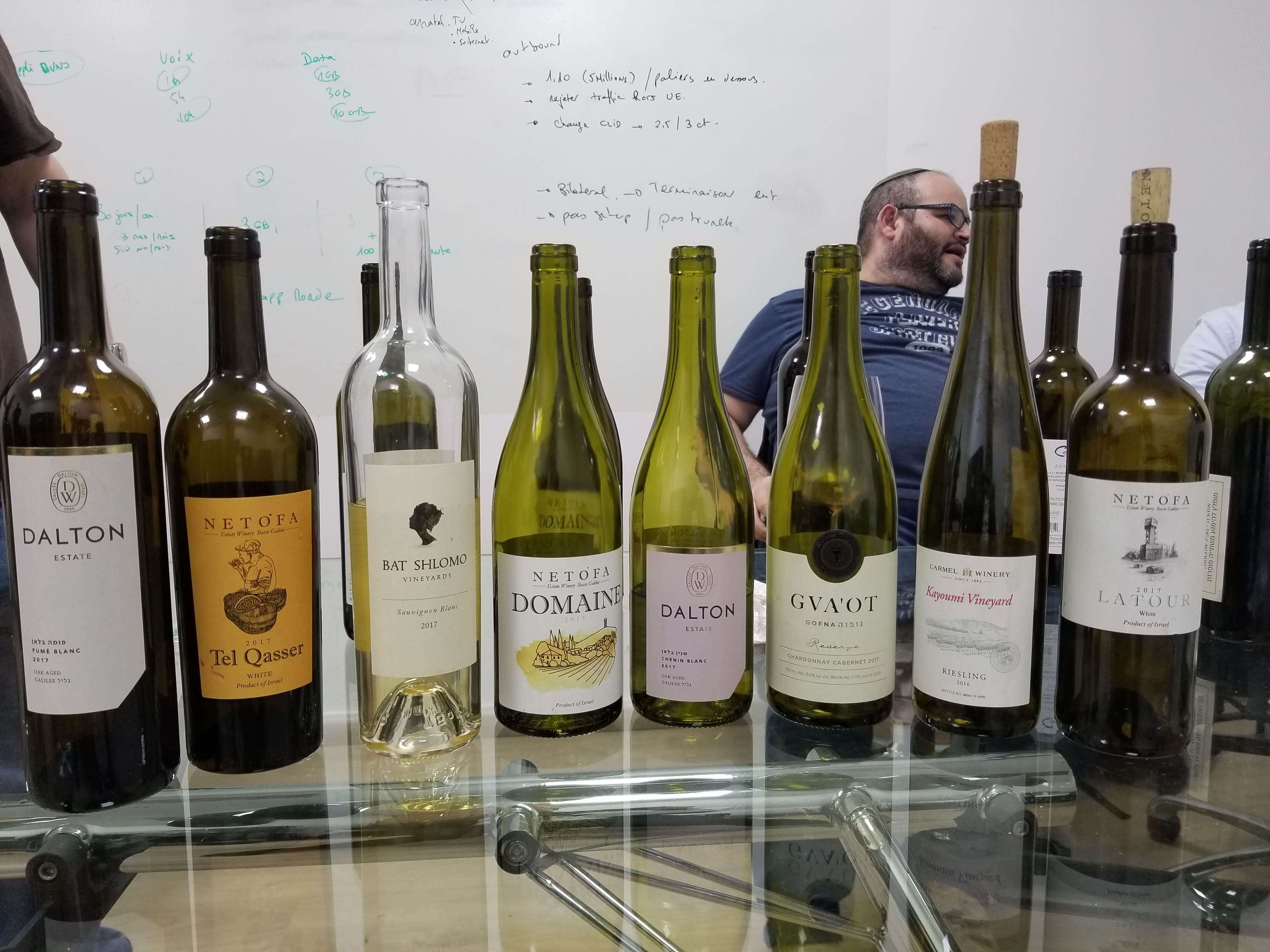
Another year and another disappointment for Israeli wines overall. I have recently returned from a quick trip to Israel to be at the last of three JK and LK’s weddings that they have thrown this year for their boys. This was the oldest son, and a young man I saw grow up before my eyes, much akin to his younger twin brothers, which as stated above, also got married this year.
This trip we tried to concentrate on reds and whites, I am done with Rose wines for the year. Much to my chagrin, the 2016 reds are a dud at best. The only 2016 red Israeli wine that I would buy, and have bought, are the 2016 Domaine du Castel Grand Vin and the 2016 Domaine du Castel Petit Castel. I will be honest, it was a shocker. Tzora’s 2016 wines and even Domaine de Netofa’s 2016 reds were ripe, riper than I would invest in. I have yet to taste the 2016 Domaine du Netofa Latour Red, I hope to taste that on my next trip to Israel.
Sadly, the 2017 whites were not much better, they all had a serious lack of complexity and acid. Sure, winemakers can and do add tartaric acid to their wines, but clearly, the wine was not showing that in ways that impressed me or others who tasted many of these wines blind.
Now, to be fair, there were some 2017 whites that did show well, and they are listed in a previous post here. With that said, the best 2017 white so far this year, that I have tasted came from Yaacov Oryah. His 2017 whites blew me away, and in 2018, he took all his red grapes and only made white and orange wines, and YES finally even a Rose wine from them! Talk about betting on anything other than red wines! Looking forward to tasting them next year! I will post the 2017 whites in my next post.
Red Wine for the masses
I know this post will offend people, and that is really not the point of the post. The point of me stating that I could care less for Israeli red wines at this point is to show the sad progression of the date juice crisis.
Look, this is nothing new, since 2009 for most Israeli wineries, and especially following the 2011 vintage (for the rest of them), Israeli wineries changed their style of winemaking to please the masses. Take Teperberg as a perfect example. Their 2011 wines were awesome, old-world in so many ways, but in 2012, they went the opposite direction and have been selling their wines in mass, to the masses, by changing their winemaking style, and yeah their labels, but everyone changed their labels. They went to a far more fruit-forward and ripe wine, one that I cannot begin to appreciate, but one that sells fantastically here in the USA, and in the end, that is really all a massive winery like Teperberg cares about.
I do not mean that in an offensive way at all. Wineries are a business and if they are not able to sell the millions of bottles that they make with a certain style of wine than they have to change the product.
That is what most of Israel’s wineries did. They changed to fruitier and riper wines and they have been succeeding so far with that approach. What that means for me, is that I will continue to concentrate on Europe and America, in terms of the wines I buy.
Too Much Wine
Besides the mass of date juice bottles that now exists on the shelves across the wine shelves in Israel, Europe, and the United States, there is just too much of it. There are new wineries popping up every year, more and more of these boutique Israeli wineries, that have no way to differentiate themselves from the next, other than more years in oak and more fruit and tannin, and of course more exclusivity and higher prices, like that would ever make me want to buy a wine! But I assure you, for the masses, it is like a moth to the flame.
The wines all taste the same. I went to a wine tasting a couple of months ago in NY, and the wines were all horrible date juice, but they were the same date juice, nothing that differentiated them from the next wine over. Not a single unique aspect.
Israel will face the issue soon if it is not already facing it now. I ask the winemakers and they say they are selling all the wines perfectly well. But when I talk to shop owners the story I get is very different. Wines are not moving and they sit on the shelves, the prices are too high, they are no different than the wine on the shelf over, and they all look the same.
Different varietals
At least a few wineries are trying to make something other than Cabernet Sauvignon, but sadly those do not sell well. There is a reason why Herzog Winery has some 20+ Cabernet Sauvignon wines! YES! 20 plus, closer to 25 or more I think. Same with Yarden and other wineries in Israel, where the focus continues to be on Cabernet.
Vitkin, Domaine du Netofa, Recanati, Capsouto, Covenant Winery Israel, Tzora Winery, and others are trying to change the ONENESS that plagues Israeli wineries, but they too have been hitting resistance. Why? Because as much as they and others talk about the need for more options outside of Cabernet, and how the ecology and terroir of Israel are more suited to Rhone or Spanish varietals, the truth is that Israeli and American palates only understand Cabernet Sauvignon. That is the sad truth. It takes a lot of money and perseverance to try to push a rock up the hill or change the palates of the kosher wine masses. So far, the date juice palates are pummeling the old-world palates. There is no real way to hide from this simple and true fact, and while I guess I could care less, I wonder when this will all come back to roost on the Israeli wineries.
As I have stated many times, red wines have at least a 2+ year cost from crush until the release and then the next red wine vintage’s release. If the public starts to move or change their desires, wineries will be left holding the bag, a very expensive bag. Until then, the wine is selling, even if they are all the same stuff. Even among the red non-Cabernet Sauvignon wineries, the wines when tasted blind really do taste the same. There is little to no uniqueness. It is just really ripe dry red wine, some showing some finesse, but for the most part, sledgehammer wines that meet the least common denominator requirement of ripe and round wines that can be consumed ASAP.
Again, I know I will receive lots of hate mail, I understand, that is fine with me. I am simply stating things as I see it. Sadly, there are others as well that have the same issues, in varying degrees, and the sad truth is that Israel does not have the desire today, to make a wine that is as good as some of the wines from California, let alone Europe. They have proven in the past that they CAN make wines that are as good as California’s kosher options, but almost all of them have sold out to what is selling today, at the cost of the lowest common denominator consumer, who are seemingly holding them all hostage.
I hope the 2017 vintage of red wines will turn things around but I highly doubt it. Sadly, the 2015 and 2016 Capcanes reds have also joined this very fruit forward winemaking approach. The 2015 Peraj Ha’abib was not a wine I bought much of if any, outside of the few I needed for three tastings. The 2016 vintage, here so far is mevushal and is a disaster. The 2016 and 2017 Peraj Petita, NOT mevushal, are not fun to horrible wines. The earlier vintages continue to show well, and time will tell for the newer vintages, the Carignan and Grenache wines, we have yet to see the 2015 vintages of those wines. The 2015 Capcances Pinot Noir was and is still very nice and 2016 is not yet available here in the USA.
The Blind Wine Tastings
There were two separate wine tastings, one at JK’s office and one at AD’s house in Beit Shemesh. My many thanks to both of these guys for putting up with me, and my many thanks to the gang of guys who joined us and brought wines, and were able to put up with me during the tastings. Those would be AD, JK, AO, OM, AK, and NA. Again, my many thanks and the wines were brought by both me and the other guests. The wines were all tasted blind with silver foil wrapping the bottles.
This content is for members only. Please Login or Subscribe Here to continue reading!


Leave a Reply to winemusingsCancel reply