
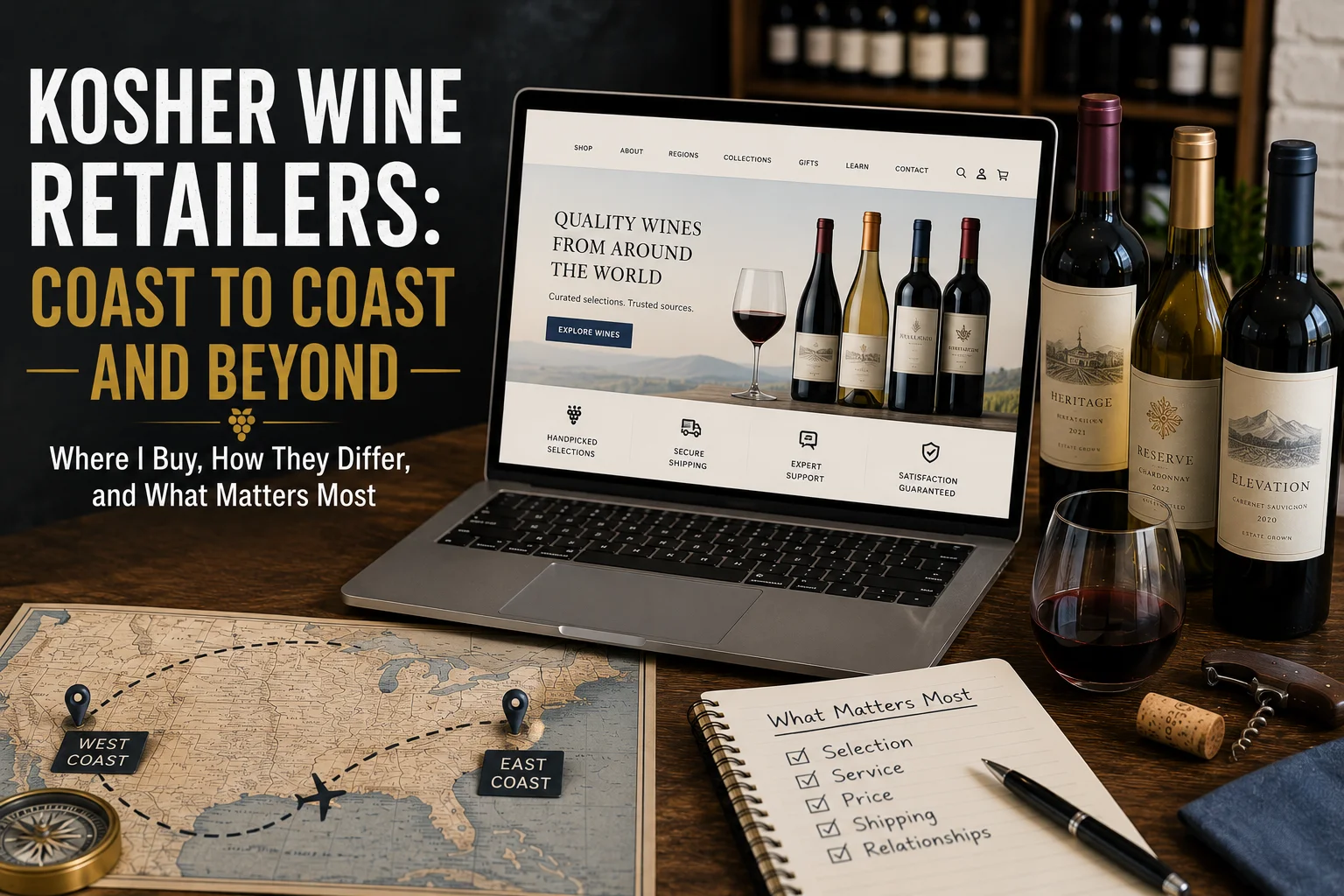
People ask me all the time where I buy my kosher wine. The answer is not as simple as naming one store, giving you a link, and telling you to go shopping.
I buy wine from many different retailers. Some are online retailers, some are physical stores I visit when I am traveling, and some are people with whom I have developed a relationship over many years.
This is also a slightly dangerous post to write. Not dangerous in the normal meaning of the word. Dangerous because the moment you name five kosher wine retailers, someone will ask why you ignored the other fifty. I am not attempting to create a complete directory of every store that sells kosher wine. I am documenting the retailers from whom I have actually purchased wine or with whom I have real experience.
I am also not ranking these retailers. I am not telling you which one is the best, which one is the cheapest, or which one deserves your business. That is going to depend on what you are buying, where you live, what the shipping costs, and what kind of relationship you want with the person selling you the wine.
Before we get to the actual list, it is worth discussing what is happening in the kosher wine retail market and how these stores are attempting to differentiate themselves.
Eighties flashback warning: I hope I am not the only one who had this song ringing in my head when I came up with the post’s title??
How Do Kosher Wine Retailers Differentiate Themselves?
One of the most common complaints I hear today is that there is very little differentiation among kosher wine retailers. You can visit five different websites and see essentially the same wines from the same major importers.
That was not always the case.
There was a time when certain wines were extremely difficult to find. Wines brought in by smaller importers, including the M&M portfolio, could be nearly impossible to purchase unless you contacted the importer directly or physically went to the correct store in New York or New Jersey.
That has improved considerably. Retailers such as Elk Wine and KosherWine.com now carry many wines that once had extremely limited distribution. The broader availability is good for the consumer, but it also means that the inventories of the major online retailers increasingly look alike.
So how do retailers attempt to stand out?
Exclusive Wines and Importing Arrangements
The most obvious method is exclusivity. A retailer may have an exclusive relationship with a winery, winemaker, or importer. If you want that particular wine, you have only one place to purchase it.
KosherWine.com has historically carried wines that were not widely available elsewhere, including wines from producers such as Yaffo and Ya’acov Oryah. Mia Luce was also, and I think is still, closely associated with KosherWine.com.
Liquid Kosher is another very different example. Andrew Breskin imports and offers wines that may otherwise be virtually impossible to obtain in the United States, including small-production and high-end wines such as Domaine Roses Camille. Liquid Kosher is not simply a traditional online wine store. It operates somewhere between an importer, a curator, and a high-end retailer.
When the exclusivity is real, it matters. If a retailer is the only reliable source for a wine you want, the decision has already been made for you.
Retailer-Specific Wine Labels
Another way retailers attempt to differentiate themselves is by creating their own wine labels.
There are stores in the New York and New Jersey area that have entire lines of wines made specifically for them. Some of those wines are legitimate one-off projects. Some have been interesting, and a few have been very good.
The Allegory wines made with the Weiss brothers of Shirah are an example of wines that have, at times, been worth discussing. There have been strong releases, including Pinot Noir and Cabernet Sauvignon.
However, many retailer labels do not interest me very much. In some cases, the supposedly exclusive wine is essentially another version of an existing wine with a different label. Sometimes both wines are sitting next to each other on the same website.
That may be useful branding for the retailer, but it is not automatically meaningful to me as a wine buyer. I am not going to purchase a wine simply because the store’s name or private label is attached to it.
Price
Price is the most obvious battleground.
If five retailers carry the same wine, one of the easiest ways to attract the buyer is to offer it for less money. That sounds simple, but comparing bottle prices alone can be misleading.
A retailer may have the lowest price on six of the wines you want and a higher price on the other six. Another retailer may appear more expensive but offer a shipping program that makes the total order cheaper.
The only number that ultimately matters is the final number at checkout.
Free or Discounted Shipping
Shipping is where the discussion gets a little more complicated. There is no such thing as free shipping. FedEx and UPS are not arriving at kosher wine stores and offering to ship cases of wine across the country for free. Someone is paying for that box, the packing material, the labor, the insurance, and the actual transportation.
Depending on the destination and the retailer’s negotiated rates, shipping a box of wine can easily cost approximately $40 to $50. Large retailers doing significant volume will receive better rates, but the cost does not disappear.
When a store offers free shipping, it is making a calculation. The store is hoping that the margin on the wines in your order will be enough to cover the shipping expense.
Years ago, a case was often enough to receive free shipping. That threshold has increasingly moved to fifteen bottles or some other larger minimum. Other retailers offer discounted shipping instead of claiming it is free.
OnlineKosherWine.com, for example, has publicly offered the CART10 coupon, which discounts shipping rather than discounting the wine itself. Other retailers may charge a fixed shipping price, provide a percentage discount, or occasionally run regional shipping promotions.
The underlying math remains the same. If someone purchases fifteen inexpensive bottles on which the retailer earns only a few dollars per bottle, free cross-country shipping can eliminate most or all of the profit. If the order contains more expensive wines with healthier margins, the retailer has more room to absorb the shipping cost.
The retailer is balancing lower-margin and higher-margin orders and hoping that, across enough transactions, the model works.
Free shipping is therefore not free. It is an incentive designed to make you purchase more wine from that retailer.
Personal Service and Relationships
The personal relationship also matters, even though it is difficult to assign a dollar value to it.
You may like working with Elk. You may like Dovid at KosherWine.com. You may like Binyamin at OnlineKosherWine.com. You may trust the recommendations of one retailer more than another, or you may prefer the way one person handles damaged bottles, shipping issues, special requests, or advance orders.
That personal connection is a real differentiator. Wine is not only a commodity, especially when you are buying rare bottles, older vintages, or wines that require proper storage and careful handling.
The Lost Art of Cellar Curation
There was once another level of differentiation that is mostly gone today: serious cellar curation.
During what I consider one of the peak periods of modern kosher wine, approximately 2012 through 2016, certain retailers and wine professionals would build complete cellars for clients.
I am not talking about selling someone a random assortment of expensive bottles and declaring that a cellar has been created. I am talking about finding specific vintages and tracking down wines with a purpose.
People would locate older Château Smith Haut Lafitte, Léoville Poyferré, Pontet-Canet, and other serious bottles. They would construct verticals, balance drinking windows, and create an actual cellar rather than simply filling a room with wine.
That was a very small and specialized moment in the history of kosher wine. Those services may technically still exist in some form, and I am sure someone will tell me that they still curate cellars. However, what commonly passes for cellar curation today is not the same thing.
We may be producing more kosher wine labels than ever, but that does not mean the kosher wine market is currently healthy. The market is difficult; consumers are purchasing less, and many retailers are working hard simply to move current inventory.
The era of carefully hunting down mature, important bottles for large private cellars has largely passed.
The complexity of the State Liquor/Wine laws that are just INSANE!
The fact that a retailer cannot just ship any wine to any state is one of the biggest reasons why wine.com was such a big hit in the early Aughts. It is SUPER hard to get all the rules and laws down. It is even harder to find ways to make those laws work for you. That is why one of the biggest and hardest issues out there is not just the cost of the wine, but which wines you can order given where you live. There are ways and means to get the wines you want, depending on where you live; it just may require a bit more effort on your part.
Where Is Kosher Wine Actually Sold?
The next question is where all this kosher wine is actually being purchased.
I do not have audited industry data, but my rough guess is that approximately 75 percent of the American kosher wine market is concentrated on the East Coast. The New York and New Jersey area remains the center of the market, both in terms of population and access.
There are meaningful Jewish communities and kosher wine markets in Chicago, Texas, and other areas. However, the depth of selection available in the New York metropolitan area is difficult to match.
Then there is the West Coast.
The California Winery Market
California has its own important group of kosher wineries and producers.
- Hagafen Cellars on the Silverado Trail in Napa Valley
- Herzog Wine Cellars in Oxnard
- Covenant Winery in Berkeley
- Shirah Wine Company
- Hajdu Wines
Hagafen and Herzog are prodigious local sellers. They have physical destinations, active visitor traffic, and a meaningful number of both kosher and non-kosher customers who come directly to the winery and purchase wine.
They also sell direct to consumers and operate wine clubs, but their business is not limited to shipping bottles to club members. They have substantial local visibility and a physical connection with their customers.
Covenant is different. They have built a real hybrid between DTC and a local winery experience. They still hold weekend tastings and patio concerts at the Berkeley winery, sometimes with Jeff himself playing saxophone. At some of the larger events I have attended, they have brought in local kosher food vendors as well, effectively turning their own backyard into a small local kosher wine festival. It is wine, food, music, and community all mixed together, and very few kosher wineries have created anything comparable. At the same time, Covenant remains a serious DTC retailer, selling through its mailing list, wine clubs, releases, and periodic promotions, with wines spanning different quality and price levels.
Shirah and Hajdu operate somewhat differently. They are more producer-driven and lean more heavily on direct-to-consumer sales, mailing lists, wine clubs, occasional events, and outside retailers.
California law makes winery direct-to-consumer sales relatively practical, and these producers understandably use that ability.
The West Coast Selection Problem
The existence of California kosher wineries does not solve the larger West Coast retail problem.
If I want the locally produced kosher wines, I am in a good position. I know the wineries, I can purchase directly from them, and they understandably want local reviewers and consumers to taste their wines.
Everything outside California is another matter.
Historically, if I wanted many of the major Israeli, French, Italian, Spanish, or East Coast-distributed kosher wines, I had to order them from a New York-area retailer. If I wanted something from a smaller importer, the situation could become even more difficult. At times, the only realistic option was to travel east and purchase the wine physically.
I complained about this regularly in my older year-in-review posts. The West Coast kosher consumer has never received the same breadth of selection as the East Coast consumer.
There have been attempts to improve the situation.
KosherWine.com attempted West Coast-oriented fulfillment and warehousing. Royal Wine also made separate attempts to improve West Coast distribution. These were not joint projects, but both recognized the same basic problem. Sadly, KW dropped out while Royal is still in the game.
From the consumer perspective, neither effort became sufficiently visible or useful. Royal’s drive is mostly around Israeli wines and even that is limited.
A retailer could have clearly marked which wines were already located in a West Coast warehouse. A customer in California could then understand that one group of wines might arrive quickly and economically, while another group would require a long cross-country shipment.
That kind of clear East Coast versus West Coast inventory system never became a meaningful part of the shopping experience.
There were also promises that local West Coast stores would gain access to a broader catalog. Those efforts did not produce a reliable, full-range West Coast retailer either.
Los Angeles has a reasonable kosher wine market, but even the better stores do not receive everything available in New York. The selection is generally a reduced and inconsistent subset of the national kosher wine catalog.
CaliforniaKosherWines is trying to reset that. Los Angeles lost its mainstay institution, The Cask, the only wine store in the Los Angeles area. CRAZY! The market as a whole is in the drain, but California has been a losing proposition for a very long time, and it makes me sad!
Most West Coast consumers therefore purchase whatever their local store happens to receive. A very small number of obsessive buyers order extensively from the East Coast, pay the shipping, coordinate around the weather, and wait for the wine to cross the country.
I am one of those absurd people.
I do not expect this post to fix West Coast kosher wine distribution. Most of my readers are probably not West Coast consumers, and the details quickly become a discussion about warehousing, distribution, inventory risk, and logistics.
Still, the reality deserves to be documented. West Coast buyers continue to receive a narrower, often haphazard selection. Anyone who wants access to the full range of kosher wines will still find themselves relying heavily on East Coast retailers.
So Which Retailer Should You Use?
I am not going to answer that question for you. This is not a ranking, and I am not choosing sides. There is no universal winner because the answer changes with every order.
You may want twelve specific wines. Another person may want fifteen entirely different wines. One retailer may have the best price on half of your order but not carry the other half. Another may charge slightly more per bottle but offer discounted shipping. A third may have a wine that nobody else carries. You need to do your own research.
Build the order at several stores. Compare the exact bottles and vintages. Add the shipping. Apply any valid promotions. Then compare the final checkout totals.
Do not compare only the advertised bottle prices. The real cost is the combined cost of the wine, shipping, taxes, and any other fees.
After that, decide whether the personal relationship matters to you. You may be willing to spend a little more with someone who knows your palate, responds when something goes wrong, stores the wine properly, and has treated you well over the years.
You may also prefer the retailer who has the simplest website and the lowest final price. There is nothing wrong with that either.
Once you remove the one-off exclusives and retailer-specific labels, much of the decision comes down to the final delivered price and the person from whom you prefer to purchase.
The Kosher Wine Retailers I Use
The following is not intended to be a complete list of kosher wine retailers. These are the retailers and stores from whom I have personally purchased wine or with whom I have direct experience.
United States Online Retailers
- KosherWine.com
- OnlineKosherWine.com
- ElkWine.com
- KosherWineDirect.com
- IDrinkKosher.com
- LiquidKosher.com
- CaliforniaKosherWines.com
- MitzvahWine.com
For transparency, Elk is a friend of mine. Andrew Breskin of Liquid Kosher is also a friend of mine. I know the person behind Mitzvah Wine as well, though I would describe that more as an acquaintance than a close friendship.
Those relationships do not make these retailers automatically better or worse than anyone else. They are simply relationships that should be disclosed.
I place the vast majority of my wine orders with Kosherwine.com simply because of the history and relationship I have with the retailer.
Physical Stores I Use in the New York and New Jersey Area
- Filler Up in Teaneck, New Jersey
- Suhag Wines in Queens, New York
- Liquor & Wine Warehouse at Green Acres in Valley Stream, New York
Liquor & Wine Warehouse is the physical store associated with I Drink Kosher. It is located at Green Acres and serves a large customer base that includes the Five Towns community.
Retailers I Use in France
- MesVinsCacher.com
- WineSymphony.fr
- Winess.com, which also has a physical store in the 17th arrondissement of Paris
These are the primary retailers I use when purchasing kosher wine in and around France. There are many small stores I pick up wines for tastings, but if I want a large order to take home, it will come from those three wine stores.
Retailers I Use in Israel
- Pyup in Ramot Eshkol
- JLM Wines
Some notes though on buying wines in Israel from Avi:
The landscape of buying kosher wine in Israel is VASTLY different from that in the rest of the world. First and foremost, you can find wine in every run-of-the-mill supermarket. This means that for your everyday wines, you are likely to find a decent selection at the place where you do most of your shopping. Some Supermarkets have rather large selections. Storage is never an issue as supermarkets are kept far cooler than your average wine store. The downside is that you will almost never find higher-end or even mid-range wines in these stores.
But while we have wine flowing in the supermarkets, where the US excels – namely online sales – Israel is squarely behind the times. We have no dependable web retailers for wine. Don’t get me wrong – there are plenty of sites selling wine – the largest of which is likely Paneco. But the problem with online retailers is how they ship. It is NEVER temperature controlled. Wine can sit on a delivery truck for hours. If it’s in the summer, your wine is cooked. On top of that, the selection usually isn’t great. There are no discounts for volume/by-the-case purchases and little care is given to what vintage you might actually get. This is my least favorite method of getting wine.
That leaves wine/liquor stores. These can be grouped into two: independent retailers and liquor chain stores. For the chain stores, some are better than others. I find many Yayin Bair locations to be insufficiently cooled. HaYevuan, on the other hand, seems to be managed much better, with a nicer selection and well-maintained storage. Some Bana locations are well stocked – others not so much. It goes on and on. You really have to know the individual branch.
With the independent retailers, you also really need to get to know your local stores. I have been to stores that have decent storage, but have zero knowledgeable salespeople. I have been to others that have incredibly knowledgeable salespeople, but the selection is very limited – or the pricing is way off. Also, for many retailers, even though storage might be good once inside the store, wine is often delivered and left outside in the scorching heat for a few hours before it is brought in. Of course that is not the case with all independents, but there are a great many who simply don’t care enough to get the wine inside quickly. Having said that, sometimes with independents, the stars all do really align, and you get a knowledgeable sales staff, nice selection, excellent service, and good pricing. But again, you have to know your individual retailer – and as these are independents, while I can point to who I usually shop from in the cities where I work or live, that is not going to help anyone living in Beer Sheva or Haifa or Netanya, etc. – so I won’t bother.
Bottom line – get to know the retailers where you live – and assess for yourself.
Final Thoughts
The kosher wine retail market has changed.
The inventories of the major retailers increasingly overlap. True exclusives still exist, but they are less common. Private-label wines exist, but they do not automatically interest me. Serious cellar curation has largely disappeared. Price and shipping have therefore become more important than ever.
That does not mean every retailer is identical. Relationships matter. Customer service matters. Storage matters. Selection matters when you are hunting for a particular wine. Geography matters, especially for those of us on the West Coast.
But there is no simple answer to the question of where you should buy your kosher wine.
Make your list. Build the same cart at several retailers. Compare the delivered price. Decide how much the personal relationship and service matter to you.
Then buy from the retailer who makes the most sense for that particular order.


Leave a Reply