
With Shavuot rapidly approaching, I am posting the top sparkling wines, but to be clear, I drink sparkling wine all year round! The truth is, we were spoiled in the past. The Golan Heights Winery produced many affordable sparkling wines that rivaled Champagnes 3x the price. Sadly, those days are over. The prices escalated, and the wines did not compare to the best in France or Italy. Thankfully, the latest batch of Sparkling wines from Israel, though expensive, has once again matched European wines in quality, whether they are more expensive or just the same price.
How is Sparkling wine made?
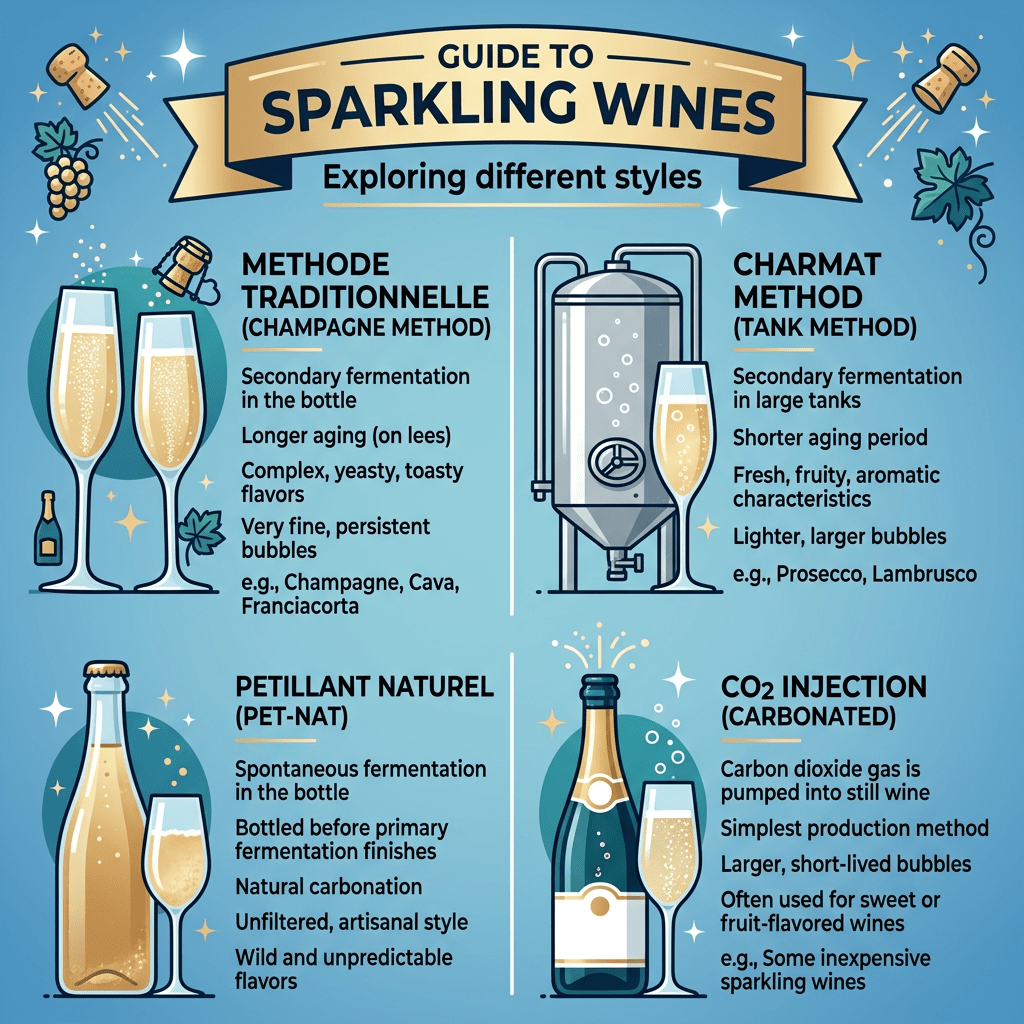
There are many options – but the vast majority of sparkling wines fall into three categories:
- Le Méthode Champenoise (Méthode Traditionnelle)
- Methode Ancestrale
- The Charmat Method
Le Méthode Champenoise (Méthode Traditionnelle)
So, what is Champagne, and how do we get all those cool bubbles? Well, it all starts with a grape of some sort, in most cases, Chardonnay, but we will get back to the other varietals further down. For now, like all wine on planet earth, Champagne starts with a grape. It is picked (often early to lower alcohol and increase acidity), then crushed, pressed, and allowed/encouraged to go through primary fermentation, exactly like all white wines on planet earth. At this point, most houses ferment the base wine in metal tanks or barrels. Some still use wood, but they are the minority.
Of course, as in much of France (Bordeaux, Burgundy, Champagne), especially in Champagne, the wine can be chaptalized after racking, up to 11% ABV. Now, before the heat waves that have covered much of this earth (call it what you wish), Bordeaux and Champagne prayed to hit their desired mark of ABV, and therefore they used to add sugar to bring up the ripeness of their fruit. Nowadays, Champagne is picking earlier and earlier, and Chaptalization is not a common thing anymore, as Mother Nature is taking care of the fruit’s ripeness all on her own!
Once the wine has been fermented, the next question arises: should they let the base wine go through a wine’s second natural fermentation, called Malolactic Fermentation? Most allow fermentation to take place and require it, a fact that is easy to achieve nowadays with controlled winery environments, though some do not like it at all. Finally, the barrels/tanks are blended, or, in the rare case, kept aside as a Vintage Champagne, meaning the base wine is sourced from a single vintage rather than a blend of a few vintages.
So, at this point, what we have is base wine, and while it may be an OK wine, it is far from what the final product will be like. Most base wines are nice enough, but it’s like licking a lemon; these wines are highly acidic and usually not well balanced at that point.
The next step is to bottle the wine, with yeast and basic rock sugar, which causes a second fermentation. The exact amounts of the two added ingredients are a house secret. The wines are closed with a simple beer bottle cap. You will notice that ALL wines made in this manner have a lip around the top of the bottle, where the cap is attached. Again, if the year is exceptional, then the wine becomes vintage champagne and is aged for at least three years. If the vintage is normal, the bottle’s contents are a blend of a few vintages and are aged for at least 1.5 years.
All the while, during the second fermentation, the wine ages and becomes more complex as the yeast works. The yeast breaks down as it ferments the rock sugar, adding effervescence and, in the process, lending a lovely mouthfeel and rich complexity. This process is known as autolysis, releasing molecules that are slowly transformed as they interact with those in the wine.
The process is a dual transformational process. First, the yeasts are broken down, but if that occurred in a 100% hermetically sealed environment, we would have SERIOUS issues, like HS (Hydrogen Sulfide) and mercaptan (think nasty rotten eggs). Oxygen is a two-edged sword; with too much, the wine oxidizes, and with too little, you get HS and a nasty foul egg smell. So, the caps that cover the Champagne bottles as they rest for 18 months to 3 years in these cool racks allow a certain amount of oxygen to flow through; the caps are not hermetic seals. The special stoppers, AKA caps, allow the wine to mature on the lees, with a very slow infusion of oxygen, thereby allowing it to mature at the rate best for it. You can mature them quicker, with a different cap, but you would lose the value of a wine sitting long on the lees.
According to Wikipedia, the effects of autolysis on wine contribute to a creamy mouthfeel that may make a wine seem to have a fuller body. The release of enzymes inhibits oxidation, which improves some of the aging potentials of the wine. The mannoproteins improve the overall stability of the proteins in the wine by reducing the number of tartrates that are precipitated out. They may also bind with the tannins in the wine to reduce the perception of bitterness or astringency in the wine. The increased production of amino acids leads to the development of several flavors associated with premium Champagne, including aromas of biscuits or bread dough, nuttiness, and acacia. As the wine ages further, more complex notes may develop from the effects of autolysis.
Finally, at this stage, after the bottles have matured for the appropriate amount of time, as indicated on their label (blend or Vintage), we reach the final stages of Champagne: remuage (or “riddling” in English) and Dosage. To get rid of the lees (the dead yeast cells and other particulates), the bottles are hand or machine-manipulated to convince the lees to move towards the cap. Then the bottle’s neck is frozen, and the cap is removed. The lees come flying out in a frozen form, and then the bottle is recapped with the famous champagne cork, but not before it is dosed with more sugar. This very last step is the reason for this post, but let’s leave it for later. For now, let’s talk varietals and color/style.
This content is for members only. Please Login or Subscribe Here to continue reading!
Leave a Reply