
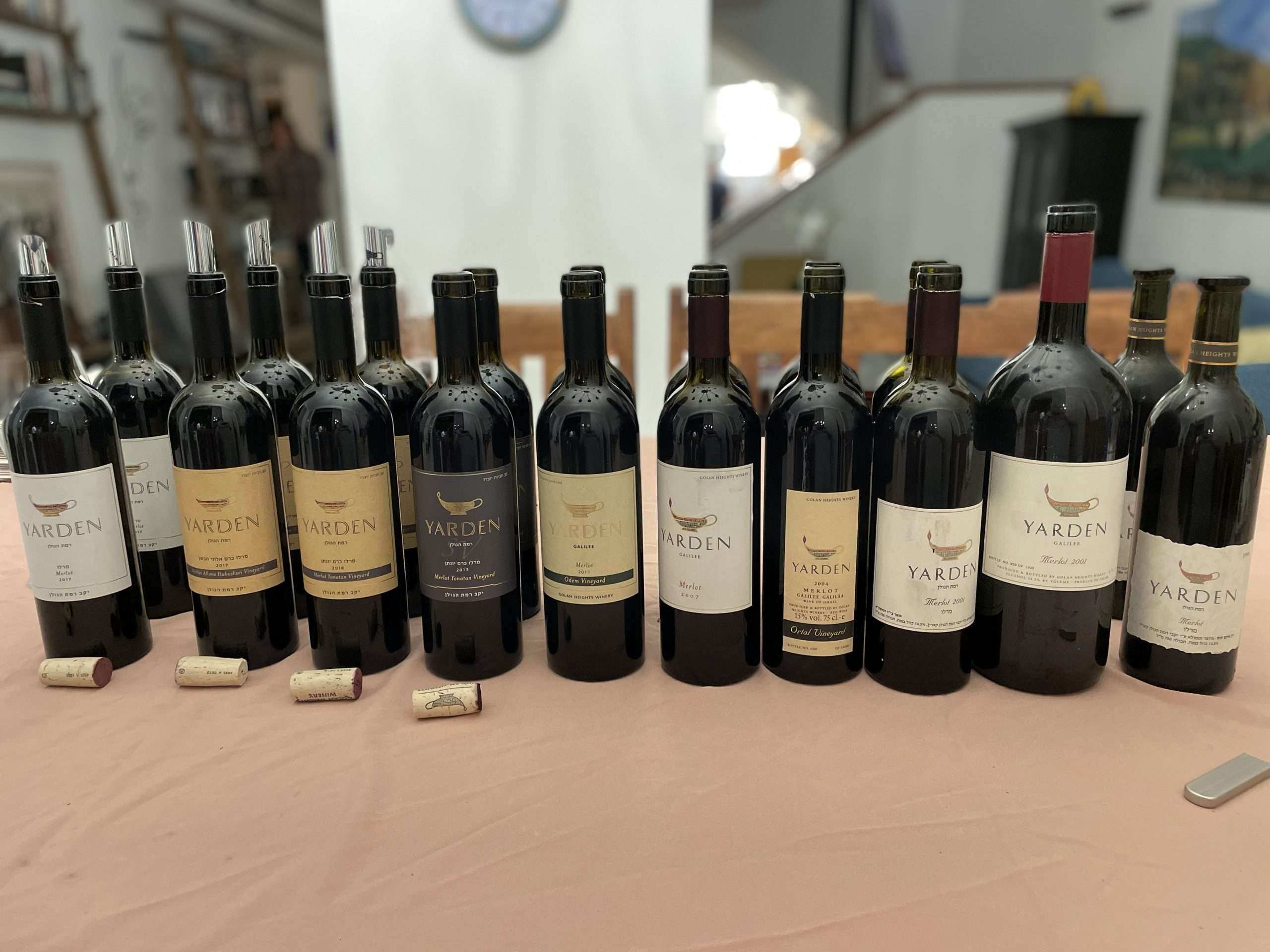
Over the last decade or so, there has been much discussion among oenophiles as to the direction that Golan Heights Winery has taken with its wines. Many feel that, as of 2009, there was a significant shift in style from more refined and restrained wines to a big opulent more fruit-forward style. There are those who feel that this perceived change was deliberate and an effort to boost sales in various markets. Others attribute this shift to a change in climate and the new riper reality that this represents.
As this really is never addressed by GHW publicly, we are only left to speculate. But before we get to that, it is important to understand why this is of interest to many of us. For at least 20 years, GHW represented THE gold standard in Israeli wine. To this day, there is no more professional winery than GHW. Technical flaws are unheard of. Each wine appears to be made exactly as intended. The process is tightly controlled – from the vine nursery to the bottling line and cellar. Really, from that perspective, GHW is on par with the very best in the world. Soon after Aliyah almost 20 years ago, I did the standard GHW winery tour. Even then, GHW’s operation was ridiculously impressive. From what I understand from those who have either worked at the winery or have gotten a more recent VIP tour, it is simply beyond comparison at this point, having undergone drastic shifts to deal with the leafroll virus and in ensuring clean rootstock and vines.
It is for this reason that the shift in 2009 was met with such surprise. It seemed to be a clear shift in style – when GHW already had a pretty massive following and was considered to be the best winery in Israel. 2008 was a STELLAR vintage all around – so it’s not like they were coming off a bad vintage and got spooked. And while 2009 was not an incredible vintage, it wasn’t horrible either (2015 and 2020 are far worse). And so, it is hard to explain this away as either purely a stylistic choice or a reaction to climate.
One person who could answer this of course would be Victor Schoenfeld – GHW’s head winemaker since the early ‘90’s. Building on what Peter Stern set up, Mr. Schoenfeld arguably improved and refined the operation at GHW, resulting in what we have to day – simply the most professional winery in the country.
As an aside, if we look at another winery that Peter Stern set up – Herzog Vineyards – and follow its trajectory, there are a number of parallels. The wines made in those early vintages are often still alive and kicking (and in all but the rarest of circumstances, they are mevushal to boot)! California also has gone through a climate change of sorts with most wineries producing riper wines than they have in the past. And yet, Joe Hurliman at Herzog made no such shift. Yes, there are vintages that aren’t great (I’m looking at you 2017) – but for the most part, Herzog has adjusted its process to account for the riper produce and is still making EXCELLENT wines that keep its traditional oenophile base happy – while also being large enough to produce ripe fruit bombs for those who want those wines as well.
But, at GHW, even though they too are certainly large enough to produce multiple styles, they have chosen not to and to simply shift styles completely. For whatever reason, GHW and Mr. Schoenfeld really never address this in public at least. So, when an opportunity came this past October to taste through a number of GHW Merlots from the 90’s through the current vintage, I thought this might give me more clarity on the matter. Sure, I had tasted all of the wines at various times over the course of the last 20 years, but all of the wines here were being sourced directly from the winery where storage could be ruled out as a factor. For the most part, I haven’t really revisited the wines from 2009 on after initial tasting, as they were not really my thing, and they are not wines that I bought. Here I would have a chance to see whether or not age – under the best storage conditions possible – balanced these wines out. Lastly, as it happens, of late, I rather prefer GHW Merlot these days rather than their flagship Cabernet Sauvignon. The extra acid better balances the riper style, and, overall, Merlot’s profile makes it less heavy to start. So I thought this really might be one of the best opportunities I would get to really see how these wines play out with a varietal that overall I find more palatable from GHW these days.
The evening was hosted by Yael Gai who is the International Sales and Marketing manager for GHW – though it was NOT an official winery event, instead being organized via the Toameha (טועמיה) tasting group. (Another quick aside – besides being all around great people and wonderful hosts, Yael’s husband prepared the best vegan bolognaise I have ever had – and I am REALLY picky – Kudos!)
The conclusions that I draw are as follows:
- There are MULTIPLE factors at work here. There are clear changes in the how the wines of the aughts have held up vs. the wines of ‘90’s. It would be foolish to conclude that a winemaker has CHOSEN to make wines that age less gracefully. At the same time the shift in styles in wines of the teens is as clear as night and day.
- Vintage and climate are incredibly important, even with wineries that have such incredibly controlled environments. As noted previously, the 2018 vintage stands out and produces wines that have an overall shot of being more controlled and of better overall quality than wines from other vintages in this decade. That will NOT compensate for style, though it may very well produce a wine that can transcends one’s personal preferences, so that even if this style isn’t 100% something you would normally choose, the quality makes it a wine that is worth sampling. That is my feeling with 85% of the 2018 GHW portfolio. Are these wines I’m going to stock up on? Unlikely. Are they wines that I would be disappointed in being served? Absolutely not.
- The shift in styles is not something that one can run away from. Outside of the 2018 vintage wines, none of the wines of the current decade were wines that I was particularly happy with. The wines of the aughts used to present much better but simply do not last as long. Is this something that was by choice or were there other factors? I don’t know…. It could very well be that the uprooting and replanting of the many of the GHW vineyards to deal with the leafroll virus has caused a decrease in quality of the grapes, as these vines, while virus resistant, simply produce fruitier sweeter wines. Or it could be simply that after assessing the market, the winery has decided that this is what sells. Period. Certainly in parts of Asia, the preferences seem to tend sweeter even more than the standard Israeli or American kosher palate – and yes GHW does business there and all over the world. I am personally of the opinion therefore that there was only one change in style – 2009 and the negative impact on longevity of the wines of the aughts I don’t think this was on purpose but simply a reaction to external factors like climate or virus
Unfortunately the only person who REALLY knows is Mr. Schoenfeld. I would love to one day get the opportunity to speak with him about this as I really do think it is a fascinating topic.
Below are quick notes and impressions on the wines tasted in the order they were presented.
This content is for members only. Please Login or Subscribe Here to continue reading!


Leave a Reply