
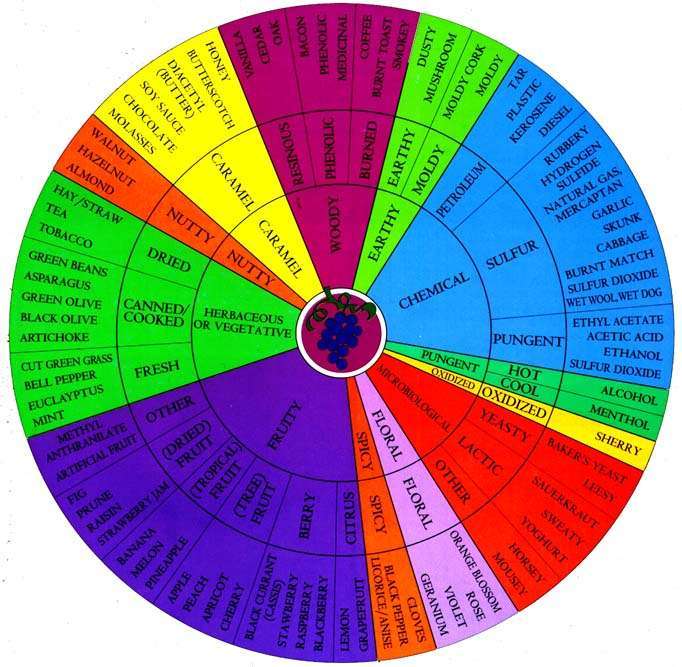
 When I put my wines notes together my friends always ask me how I can do it. Did I really taste grapefruit or mushroom? Honestly, I did not realize how I was doing it originally, but as I tasted more and more wine, I realized I was actually smelling unique aromas and tasting unique flavors. To start I knew I was smelling green notes or tasting tropical fruit, but it took me time to really pull the mint or the pineapple/guava from a glass of wine. Initially, I did not realize what I was doing but then one day my wife shows up with this wheel and hands it to me saying, “Enjoy”! WOW! I took one look at the wheel and all of a sudden I realized I was living the wheel! After a bit of investigation I realized that the wheel is called the Wine Aroma Wheel. The genius of the wheel is that it scientifically describes wine flavors and aromas from their most generic all the way to their most specific. Now of course, the wheel could not possibly denote every single wine flavor or aroma, still, it lists many of the common aromas and flavors. The genius of the wheel is its circular encoding!
To be honest, detecting aromas at the start is difficult to some. For fun try to describe what a pineapple smells like. It may look like a large pinecone, but it smells NOTHING like one. A pineapple is highly citric in nature and sweet at the same time, very few things out there are like that, hence it being part of the tropical family of aromas and tastes. If you read my notes they gyrate from the purely academic nose, mouth, mid palate, finish style to the poetic and nostalgic, though always giving data about the wine. So, is a wine really smoking a fat stogy while wearing a long leather coat and lying on a bed of vanilla? Of course not, it is simply a poetic way to say the wine has notes of vanilla, tobacco, and a mouth feel with leather. Still, they are a far cry from each other, and to the beginner they may both be hard to see in a glass of wine.
So, along comes Dr. Ann Noble, a sensory chemist who earned her Ph.D. in Food science from the University of Massachusetts. She was hired by the University of California at Davis (UC Davis) in 1974 to work in their sensory research program. After studying the techniques and application of wine tasting, Noble discovered that there was no objective framework or widely agreed upon terminology that a wine taster could use to describe things such as “earthy” aromas or the different smells of various fruits that can show up in a wine. In 1984, her research lead her to develop the “Aroma Wheel”. Since then the wine wheel has been used by hundreds of thousands of people wanting to be able to codify and describe, in a fashion that is uniformly (more on that later) accepted, just exactly what they are smell and taste.
Leave a Reply